Commercial Mold Remediation Nashville, Built Around Your Business Hours
A mold finding in a commercial building is two problems at once: growth to remove, and a business that cannot simply close while it happens. Commercial mold remediation Nashville owners, managers and landlords rely on is planned around both: containment that seals the work zone off from the rest of the building, documentation that insurers and tenants can read, and scheduling that keeps trading floors, classrooms and dining rooms open wherever it is safe to do so. This page explains how a commercial job runs, and connects you with independent local providers who do the work.
- Contained work zones, building stays open
- Phased and after-hours scheduling
- Documentation for insurers and tenants
- Independent local providers
How commercial mold work differs from a house job
Commercial mold remediation in a Nashville building runs while the business keeps running: the affected zone is sealed under containment and negative air, growth and damaged material are removed, the HVAC path that spread it is cleaned, and clearance testing closes the job. Documentation for insurers, landlords and tenants is produced as the work goes, not after.
The buildings differ, and so do the stakes. A homeowner answers to a family. A property manager answers to an insurer, a landlord, a lease, a health inspector and a floor full of tenants, sometimes all in the same week. The remediation itself follows the same standard used on homes, the ANSI/IICRC S520 process of containment, removal, cleaning and clearance. What changes is everything around it: who has to be told, what has to be proved, and how much of the building has to keep working while the barrier is up.
Nashville commercial stock makes its own pattern. Downtown towers and Green Hills offices run large shared air handlers. Restaurants along Charlotte Pike and in East Nashville fight kitchen humidity and walk-in cooler condensation. Schools and churches across Davidson County sit closed and unconditioned through humid summer breaks, which is when growth takes hold. Rental portfolios in Madison, Antioch and Hermitage deal with tenant-reported mold one unit at a time. Each of those is a commercial job, and each runs on the same sequence below.
Commercial mold remediation Nashville: the job, building by building
Different buildings, same discipline: contain it, remove it, prove it, and keep the rest of the property working.
Offices and professional buildings
A musty floor, complaints at one end of a suite, growth found above a ceiling tile during a refit. Office work is usually one contained zone at a time, with the air handler checked first, because a shared system is the usual reason one leak becomes a whole floor's problem.
Retail and restaurants
Trading hours rule the schedule. Dining rooms, kitchens and stock rooms are remediated in phases, heavy stages after close, so the business keeps serving. In food premises the health inspection file matters as much as the cleanup, and the documentation is written with that reader in mind.
Schools and churches
Buildings that sit closed through Nashville's humid summers are classic mold buildings: no air movement, condensate forming, growth established before the fall term or the first service back. Work is scheduled against the academic calendar and the service schedule, and clearance results go to the board or trustees in writing.
Rental portfolios and property managers
One unit or forty, the job is the same: respond in writing, inspect properly, fix the moisture source, then remediate. Managers use this service to route each report to a local provider and to keep a paper trail, photos, readings, scope and clearance, that stands up if a tenant dispute reaches a lawyer.
How a mold inspection worksHealthcare and care settings
Clinics, dental offices and care homes carry occupants who are more vulnerable to airborne irritants, and regulators who read the file. Containment discipline, negative air and independent clearance testing are not optional extras here; they are the core of the scope, agreed before work starts.
Before you sign a scope
Commercial pricing follows the same published benchmark logic as home work: size of the contained area, material removal, HVAC involvement and clearance testing. Our cost guide lays the ranges out plainly, so a facilities budget can be set before quotes arrive.
Mold remediation cost guideKeeping the building open while the work zone is sealed
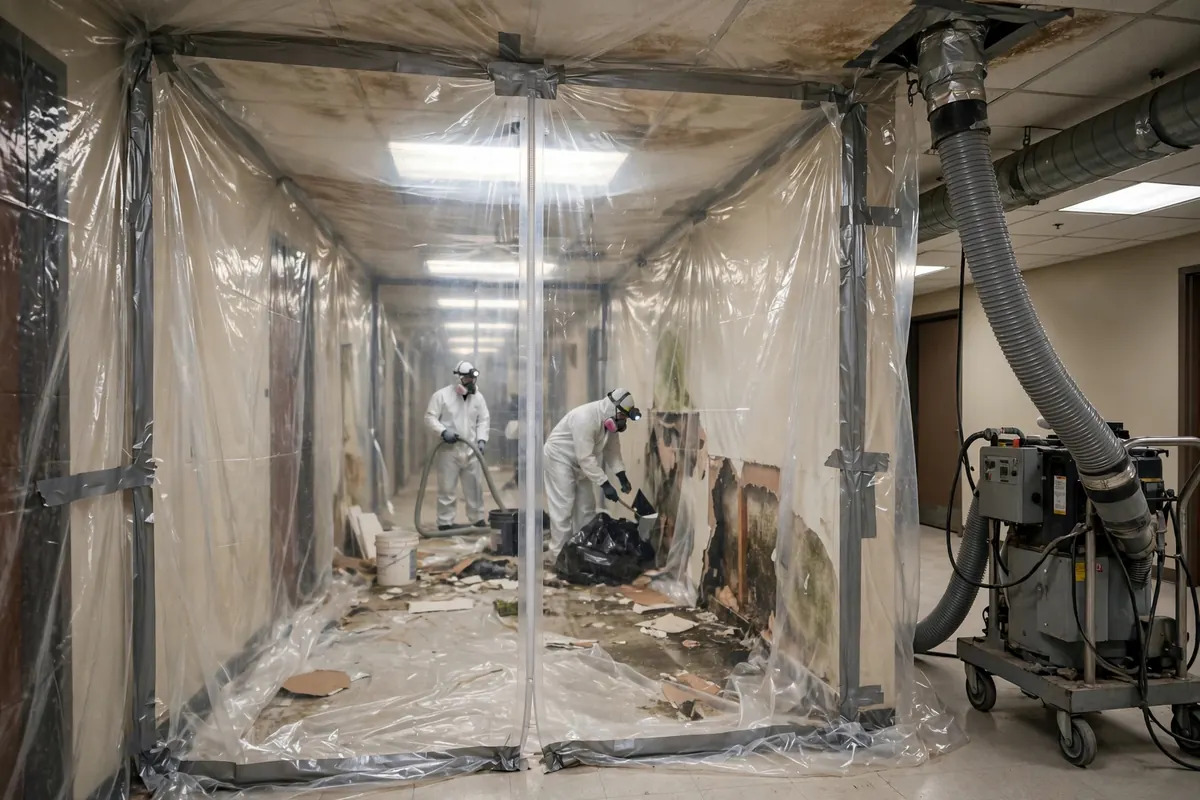
Containment is the technology that makes commercial remediation possible. The affected area is sealed in plastic sheeting with a zippered entry, and a negative air machine holds the pressure inside the barrier slightly lower than the corridor outside, so air flows in, never out. Workers and waste leave through the barrier in sealed bags. Outside that zone, the building reads as normal: no dust, no debris, no spore load drifting into occupied rooms. A building manager should be able to walk a tenant past a properly contained job and have nothing to explain.
The HVAC system is the second half of the job. In commercial buildings the air handler is both the usual suspect and the usual spreader: condensate pans overflow, coils stay wet, duct insulation gets damp, and the system distributes the result to every register it serves. A commercial scope that cleans the rooms and ignores the air path has done half the work. Expect the inspection behind any serious quote to include the handler, the pans and the duct runs near the affected zone, and expect mold testing to be offered where the spread is unclear, so the scope is sized on evidence.
- Phased by zone. One suite, one classroom wing, one trading section at a time. The building stays in use, and each phase is cleared before the barrier moves.
- After-hours heavy stages. Demolition and containment setup are loud and disruptive, so they are scheduled for nights and weekends on trading premises. Cleaning and clearance run in normal hours.
- HVAC checked as part of the job. Pans, coils, duct insulation and filters near the zone are inspected and cleaned or replaced as the scope requires.
- Clearance closes each phase. Visual inspection and, where agreed, independent air testing confirm the zone is clean before the barrier comes down and staff move back in.
A commercial job, step by step
Inspect and map
The visible growth is only the start. Moisture readings, the HVAC path and the floors above and below are checked so the scope covers the whole problem, not just the patch that was reported.
Agree the written scope
Zones, phases, working hours, what comes out, what gets cleaned, and how clearance is proved, all in writing, with the price itemized. This document is what insurers, landlords and tenants will read later.
Contain and remove
Barriers go up, negative air runs, and growth plus damaged material come out in sealed bags. The moisture source, a pan, a pipe, a roof detail, is fixed in the same visit window.
Clean, test, hand back
Surfaces are cleaned, the air path is addressed, and clearance confirms the zone before the barrier drops. You receive the file: photos, readings, scope and clearance result.
Choosing a commercial provider
Tennessee has no standalone mold license. For larger jobs the licensing checks that matter are the S-Mold designation and the home improvement license bands, plus work that follows ANSI/IICRC S520. Our guide to mold remediation companies in Nashville walks through every check, the questions to ask, and the red flags, and it discloses plainly how this referral service itself works.
Common questions about commercial mold work
Can our business stay open during commercial mold remediation?
Usually yes, in the parts of the building outside the contained work zone. A commercial job seals the affected area under plastic containment with negative air pressure, so the rest of the building can keep trading, teaching or worshipping while removal happens inside the barrier. The exceptions are jobs where the HVAC system itself is contaminated and has to be shut down, or where the affected area is the only kitchen, restroom block or entrance. Your provider should tell you which parts stay open, in writing, before work starts.
What documentation do insurers, landlords and tenants need?
Three files cover most of it: the inspection record with photos and moisture readings showing what was found, the written scope showing what was removed and cleaned, and the clearance result showing the area passed after the work. Landlords and tenants usually need the same file from different sides: proof the problem was real, and proof it was fixed properly. A commercial provider who works for property managers produces this documentation as the job runs. If you have to chase it afterwards, choose a different provider next time.
How long does a commercial mold job take?
A single contained room or office suite is often two to five days of active work. A floor of a building, or a job tied into the air handling system, runs longer, and clearance testing adds lab turnaround on top. Phased work, one zone at a time so the building stays in use, stretches the calendar while shrinking the disruption. Ask for both numbers in the scope: days of active work, and the calendar date the clearance result is expected.
Does commercial insurance cover mold remediation?
It depends on the cause, the same sudden versus gradual logic as a home policy, with one extra sting: many commercial policies carry a mold or fungi sub-limit that caps what is paid for mold work regardless of the size of the loss. A burst pipe that is reported and dried promptly is a far stronger claim than a slow condensate leak found months later. Read the sub-limit in your policy before you sign a scope, and document the discovery date with photos and readings.
How does mold spread through a whole commercial building?
Most often through the air handling system. A condensate pan that overflows, a wet coil, or damp insulation inside a duct run gives growth a home, and the system then delivers spores to every room it serves. The other common path is a hidden plumbing or roof leak wetting the same wall cavity across several floors. That is why a commercial inspection checks the HVAC system and the floors above and below the visible growth, not just the patch you can see.
Can the work happen at night or on weekends?
Yes, and on commercial jobs it often does. Restaurants, retail and offices commonly schedule the loud, disruptive stages, demolition and containment setup, outside trading hours, with cleaning and clearance steps in normal hours. After-hours scheduling is a planning choice to agree in the scope, and it is one of the main reasons commercial remediation is priced and scheduled differently from the same sized job in a house.
Mold in a building you manage?
Get it inspected, scoped in writing and contained before it spreads through the air system. Reach out now to connect with a local commercial provider. For the residential side of the service, start at the mold remediation Nashville homepage, and for the space under the building, see crawl space mold remediation.
Get Help Now