Bathroom Mold Removal Nashville, From Shower Grout to Sound Walls
The bathroom is the wettest room in the house, and it shows: dark lines along the caulk, spots blooming on the ceiling paint, a grout pattern that returns a month after every scrub. Bathroom mold removal Nashville jobs divide cleanly into two kinds: surface growth that cleans off tile and grout, and growth behind tile and drywall that has to come out. This page explains how to tell which one you have, what the removal job looks like, and the fan and plumbing fixes that stop it coming back. This service connects you with independent local providers who do the work.
- Surface versus behind the wall, told apart honestly
- Fan and leak fixes included in the scope
- Itemized clean versus remove decisions
- Independent local providers
Why bathroom mold is a steam and leak story
Bathroom mold removal in Nashville splits by depth. Mold on grout, tile and caulk is a cleaning job; mold behind tile or inside drywall is a removal job, because cleaning cannot reach it. Either way the job ends with the moisture: the exhaust fan, the caulk lines and the slow drip.
Start with the load the room carries. Every shower pumps a kettle's worth of steam into a small tiled box, and Nashville's summer air arrives humid before the water even runs. Against that load, most bathrooms defend themselves with one modest exhaust fan, grout and caulk lines that age out in a few years, and plumbing connections hidden inside walls. The mold in bathroom Nashville homes most often traces to one of four causes: steam that never leaves, a fan that is weak, missing or vented nowhere, grout and caulk that have failed and let water behind the tile, and slow leaks at the tub, the toilet base or the sink supply lines that wet the same spot for months.
The housing stock decides which cause leads. Older bathrooms in East Nashville, Inglewood and Germantown often have no fan at all, or a window that stays shut through winter. Postwar ranches in Donelson and Madison pair small baths with fans vented into the attic, which trades a bathroom problem for a roof deck problem. Newer builds in Bellevue, Smyrna and Mount Juliet have proper fans and the same caulk and supply line failures as everyone else. The diagnosis is quick; the honest answer about depth is what matters.
Bathroom mold removal Nashville: surface growth, or growth behind the wall
Mold on grout, caulk and tile
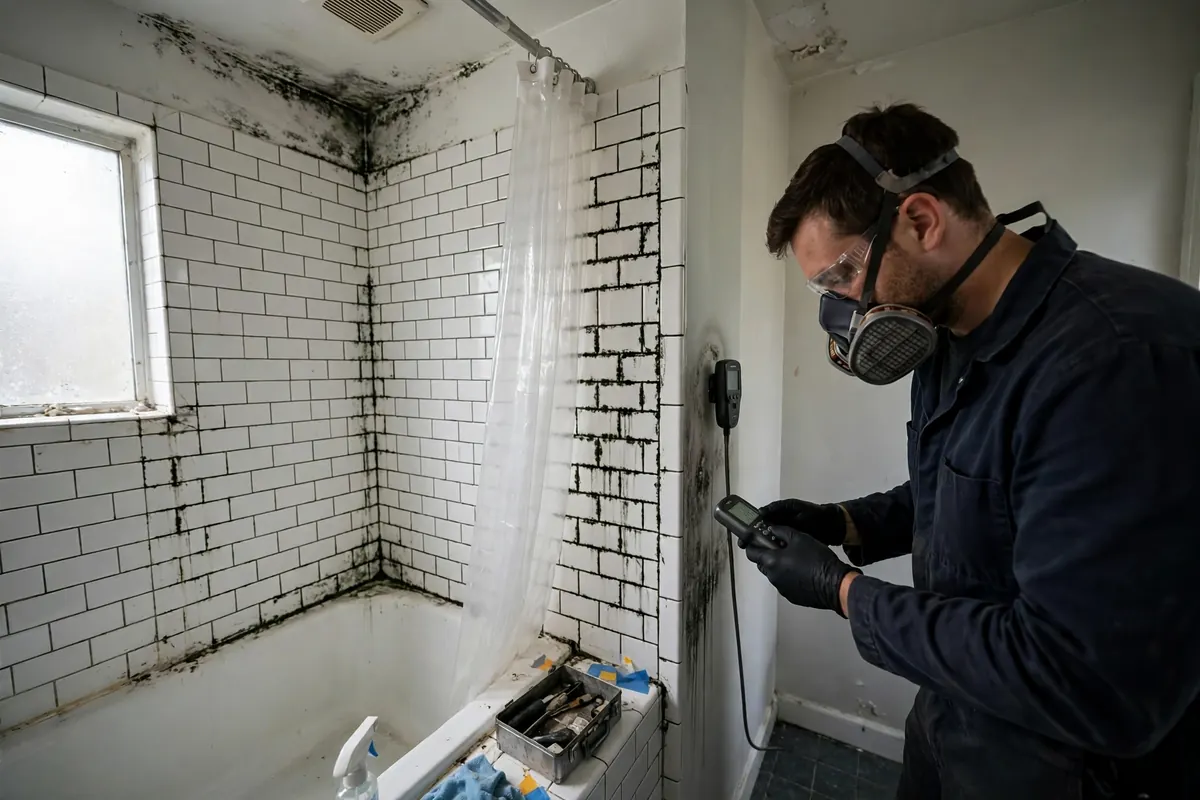
This is the visible kind: dark or pink staining along the caulk line, spots in the grout joints, a film on the tile and glass. Shower mold removal Nashville work is usually this kind, and it is a cleaning and renewal job: the growth is scrubbed and treated, failed caulk is stripped out and replaced, and grout is cleaned or renewed where it has crumbled. Nothing structural is involved, provided the wall behind is dry and sound, which is the thing to verify before anyone starts scrubbing.
Mold behind tile and drywall
The second kind announces itself differently: a musty smell that survives a deep clean, paint bubbling beside the tub, grout lines that stain from behind, drywall that feels soft at the base, or a floor that gives slightly near the toilet. Water has been entering through failed grout, a leaking valve or a supply line, and the growth is on the back of the wall, not the face. That is where bathroom mold remediation Nashville scopes begin: containment, a careful opening, removal of what has grown through, and moisture readings that map how far it traveled. When the depth is unclear, a mold inspection with meter readings settles it before money is spent on the wrong job.
- Cleaned in place. Tile, grout that is sound, glass, porcelain, sealed stone and the tub or shower base itself. Hard, nonporous surfaces clean fully, and the growth on them is a surface story.
- Usually removed. Moldy drywall and backing board behind tile, swollen subfloor at the tub and toilet, vanity bottoms made of particleboard that have soaked and grown. Porous material cannot be cleaned through its depth.
- Always renewed. Failed caulk. It is a wear item with a life of a few years, and every bathroom scope should strip and replace it rather than smear new caulk over old growth.
- Always addressed. The water path: the fan, the grout, the drip. A scope that cleans the bathroom and fixes none of the three is a scope for a monthly routine.
The exhaust fan question
More bathroom mold is decided by the exhaust fan than by any cleaning product. A working fan does three things: it is sized to the room, so it can actually change the air; it runs long enough, a full 20 to 30 minutes after the shower ends, on a timer if nobody will stand there and wait; and it vents outside, through the roof or the wall, so the steam leaves the house entirely. Fans fail on all three counts in Nashville homes: undersized builder fans, switches flipped off with the light, and ducts that end in the attic, where the steam condenses on the roof deck and starts the problem covered on our attic mold removal page.
The test is simple. A fan that cannot hold a tissue against its grille while running is moving too little air, and a duct you cannot trace to an outside vent is a duct to question. Fan replacement and proper ducting are ordinary handyman and electrician work, and they belong in the same conversation as the removal scope, because they are the difference between a bathroom that stays clean and one that gets scrubbed forever.
Kitchen mold removal Nashville: usually a plumbing story
Kitchens grow mold quietly and almost always from plumbing, not steam. The classic sites are the cabinet floor under the sink, where a trap or supply connection drips for months onto particleboard; the dishwasher line and its drain hose, which leak behind the machine where nobody looks; and the refrigerator water line feeding the ice maker, a thin tube that pinholes and wets the floor and wall behind the fridge. Kitchen mold removal Nashville jobs therefore start with the plumbing: find the drip, repair it, then judge the materials. A soaked cabinet bottom and moldy drywall behind it come out; the framing, the floor structure and hard surfaces are cleaned and dried.
The kitchen version of the bathroom rule applies: growth you can see on a hard surface cleans off, growth inside a cabinet panel or a wall does not. A musty smell when the under sink cabinet opens, a cabinet floor that has swollen or gone soft, or a fridge line with a green crust at the joint are the early signs, and they are cheap at that stage. Water readings and a look behind the dishwasher settle the size, the same inspection approach as the bathroom.
Prevention, and what a bathroom job costs
Prevention in a bathroom is a short list of habits. Run the fan during every shower and for 20 to 30 minutes after, on a timer if the switch will not get used. Treat caulk as a wear item: when it cracks, splits or lifts, strip and replace it before water gets behind it. Fix drips at the first sign, a supply line that sweats and stains, a toilet that rocks on a failing wax ring, a tub spout that diverts poorly, because slow water is what turns a cleaning job into a removal job. Leave the shower door or curtain open after use so the enclosure dries, and keep paint in wet rooms to bathroom rated finishes that tolerate the steam.
On cost: small, contained bathroom jobs sit at the low end of the published ranges. One ranking local operator publishes a typical range of $750 to $3,500, and published benchmark ranges put most Nashville mold jobs between $1,400 and $5,500, with a middle around $2,200. A surface job, cleaning, treatment and recaulking, prices at the bottom of that picture; a behind the wall job is priced by the area opened, and the rebuild of tile and drywall is a separate line. Every figure here is a published benchmark, not a price from this site. The full cost picture, including what moves a quote and what to ask before signing, is in our mold remediation cost guide.
Common questions about bathroom mold
How much does bathroom mold removal cost in Nashville?
A small, contained bathroom job is at the low end of the published ranges: one ranking local operator publishes a typical range of $750 to $3,500, and published benchmark ranges put most Nashville mold jobs between $1,400 and $5,500, with a middle around $2,200. The price turns on depth. Surface growth on grout and caulk is a cleaning visit; growth behind tile or inside drywall is a removal job priced by the area opened, and the rebuild, new drywall, tile and paint, is a separate stage. Every figure here is a published benchmark, not a price from this site: this service performs no work.
Is shower mold dangerous?
The honest answer is measured. The molds that line shower grout are common household molds, and a small amount on a hard surface is a cleaning problem, not an emergency. Larger amounts, growth spread across walls and ceilings, or growth you cannot see behind tile deserves professional attention, and anyone with asthma or breathing trouble should be more careful than average. What does not help is panic about color: black growth is not automatically the dangerous kind, and naming a species takes a lab sample. If symptoms are the concern, that is a conversation for a doctor alongside the cleanup.
Can I just regrout or recaulk over the mold?
No, and it is one of the most common ways a small job becomes a big one. New grout or caulk over live growth seals moisture and food behind a fresh surface, and the mold works through the new line within months, usually staining it from behind. Caulk is a wear item: the correct sequence is to strip the failed caulk, clean and dry the joint fully, then recaulk. If the growth is behind the tile rather than on it, fresh grout only hides the problem while the wall behind it keeps growing.
How long does bathroom mold removal take?
Surface work is fast: cleaning, treating and recaulking a shower or tub surround is typically a single visit. A behind the wall job runs in stages: containment and opening, removal of moldy drywall or subfloor, cleaning and drying verified by readings, then clearance before the wall closes. The remediation itself is often one to three days; the rebuild that follows, tile, drywall, paint, is a separate scope and schedule. Ask for the two timelines separately, the same as any other restoration job.
I rent my home. Is bathroom mold my problem or my landlord's?
Both sides have a part, and the paper trail decides it. Tenants control the daily moisture: running the fan, reporting drips early, not letting caulk failures sit. Landlords carry the building side: working ventilation, sound plumbing and a roof and walls that keep water out, and Tennessee landlords hold a general duty to keep rentals habitable. Put the report in writing, dated, with photographs, and keep a copy. A documented inspection is usually what turns an argument into a repair, whichever side of the lease you sit on.
Why does the mold come back a month after I clean it?
Because cleaning removed the growth and left the water. The usual reasons are a fan that is too small, never run or vented nowhere, caulk that has failed and lets water into the wall at every shower, or a slow drip at a supply line wetting the same spot daily. Surface mold that returns on the same line is the room telling you the moisture path is still open. Fix the path and the cleaning starts to hold; skip it and the scrubbing becomes a monthly routine.
The grout lines are dark again?
If the growth keeps returning, the room is telling you the moisture is still there. Reach out now to connect with a local provider who will check behind the tile before quoting the cleaning. Start from the mold remediation Nashville homepage for the full service, or read how to judge any firm in our guide to mold remediation companies in Nashville.
Get Help Now